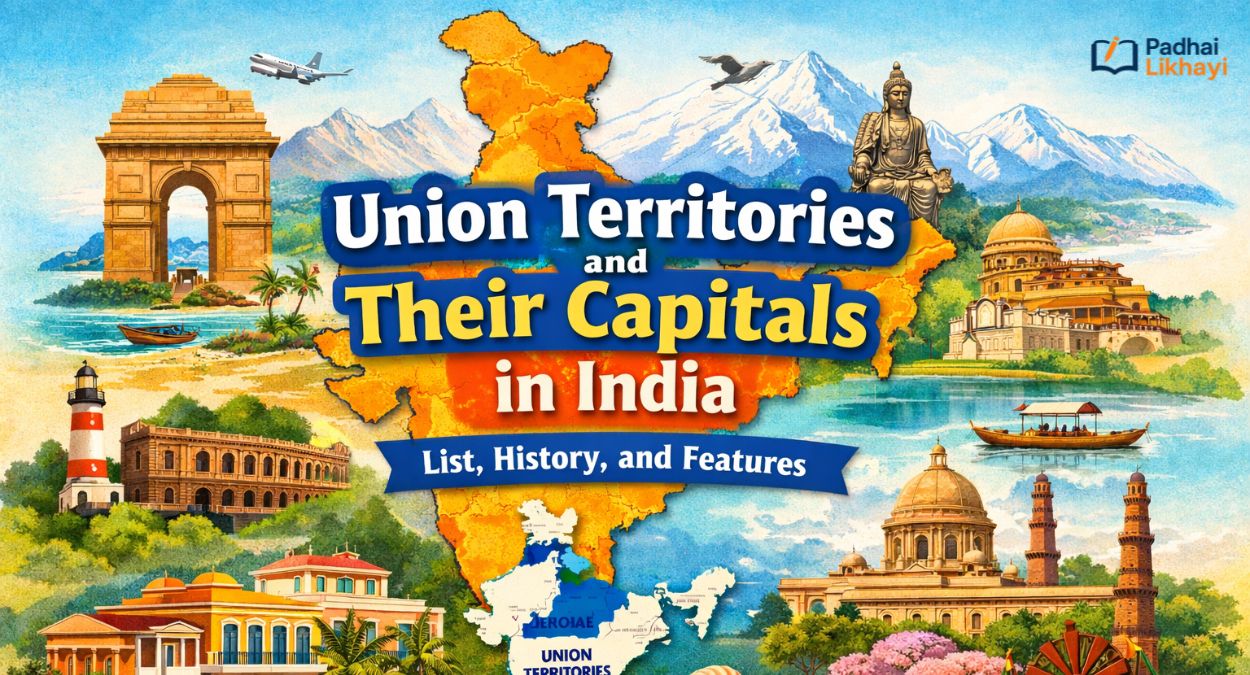
India is a large and diverse country made up of states and Union Territories. Each part of the country plays an important role in administration and development. States have their own governments, but Union Territories are governed in a different way. They are managed directly by the Central Government, which ensures better control and smooth administration in special regions.
Knowing Union Territories and Their Capitals is important for students, competitive exam aspirants, and anyone who wants to understand how India is governed. These regions have unique histories, cultures, and purposes. Some hold strategic importance, while others were formed for administrative convenience.
This article will discuss the meaning of Union Territories, their capitals, their background, and their key features. Candidates who are preparing for the government exams can learn about Union Territories and Their Capitals in India here.
What Are Union Territories?
Union Territories are special administrative regions in India that are governed directly by the Central Government. Unlike states, they do not have full powers to make laws on their own. Instead, an Administrator or Lieutenant Governor is appointed by the President to manage them.
Some Union Territories, such as Delhi and Puducherry, have their own elected assemblies with limited powers, while others are completely under central control. These territories were created for better administration, national security, cultural reasons, and historical factors. Understanding Union Territories and Their Capitals helps government exam aspirants to excel in General Knowledge section and learn how India ensures balanced and effective governance.
Union Territories and Their Capitals in India
Union Territories have their own capitals, just like states. The table below shows the Union Territories and Their Capitals with their creation date:
| S.No | Union Territory | Capital | Date of Creation |
|---|---|---|---|
| 1 | Puducherry | Puducherry | 1 November 1954 |
| 2 | Andaman and Nicobar Islands | Port Blair | 1 November 1956 |
| 3 | Chandigarh | Chandigarh | 1 November 1956 |
| 4 | Lakshadweep | Kavaratti | 1 November 1956 |
| 5 | Delhi (NCT) | Delhi | 1 November 1956 |
| 6 | Jammu and Kashmir | Srinagar (Summer), Jammu (Winter) | 31 October 2019 |
| 7 | Ladakh | Leh | 31 October 2019 |
| 8 | Dadra and Nagar Haveli and Daman and Diu | Silvassa and Daman | 26 January 2020 |
Historical Background of Union Territories in India
The concept of Union Territories was introduced after India reorganized states in 1956. Some regions could not be merged with nearby states due to cultural, strategic, or administrative reasons. These areas required direct control from the Central Government to ensure stability and development.
Over time, some Union Territories were later converted into states, while others were created due to changing political needs. In 2019, Jammu and Kashmir was reorganized into two Union Territories: Jammu and Kashmir and Ladakh. This history shows how Union Territories evolved to support better governance and national unity.
Constitutional Provisions for Union Territories
The Constitutional provisions for Union Territories in India are explained in Part VIII of the Indian Constitution, mainly under Articles 239 to 241. These articles define how Union Territories are governed and administered.
- Article 239 states that the President of India administers Union Territories through appointed administrators.
- Article 239A, added in 1962, allows Parliament to create local legislatures and governance systems for specific Union Territories.
- Article 239AA, introduced through the 69th Constitutional Amendment Act in 1991, gives special administrative powers and legislative provisions to the National Capital Territory of Delhi.
Features of Major Union Territories and Their Capitals
Union Territories are known for their special identity, culture, and location. Below are some key highlights of major Union Territories and their capitals.
Andaman and Nicobar Islands
Port Blair is the capital of Andaman and Nicobar Islands. The region is known for clean beaches, tropical forests, and rich marine life. It also holds great historical value because of the Cellular Jail, where freedom fighters were imprisoned during British rule.
Lakshadweep
Kavaratti is the capital of Lakshadweep. This Union Territory is made up of small coral islands and beautiful lagoons. Fishing and tourism are the main sources of livelihood. Its calm environment and crystal-clear waters attract visitors from across the world.
Puducherry
Puducherry has its capital at Puducherry city. It was once a French colony, and even today, many buildings, streets, and churches show French design. The city is known for peaceful beaches, educational institutions, and cultural harmony among communities.
Delhi (National Capital Territory)
New Delhi is the capital of the National Capital Territory of Delhi. It is the political center of India, where important offices like the Parliament, Rashtrapati Bhavan, and Supreme Court are located. Delhi also has a special administrative setup with its own legislative assembly.
Jammu and Kashmir
Jammu and Kashmir has Srinagar as the summer capital and Jammu as the winter capital. The territory is famous for scenic mountains, rivers, and valleys. Tourism, horticulture, and handicrafts are important parts of its economy.
Ladakh
Leh is the capital of Ladakh. It is known for high mountain ranges, clear skies, and monasteries. Ladakh also has strategic importance because it shares borders with other countries. The cold climate and unique culture make it different from the rest of India.
Chandigarh
Chandigarh is both a Union Territory and the shared capital of Punjab and Haryana. It is a planned city designed by architect Le Corbusier. The city is clean, organized, and known for good infrastructure and public services.
Dadra and Nagar Haveli and Daman and Diu
This Union Territory has two capitals, Silvassa and Daman. It has a mix of tribal culture and Portuguese influence. The region is known for industries, beaches, and simple lifestyle. Tourism and manufacturing are important here.
| Also Check |
|---|
| List of International Airlines in India 2025 |
| UNESCO World Heritage Sites in India |
| Children’s Day 2025 |
| World Organisations and Their Headquarters |
FAQs
Q.1. How many Union Territories are there in India?
Ans. There are eight Union Territories in India.
Q.2. Which Union Territory has two capitals?
Ans. Jammu and Kashmir has two capitals: Srinagar and Jammu.
Q.3. Which is the smallest Union Territory in India?
Ans. Lakshadweep is the smallest Union Territory.
Q.4. Which Union Territory is the National Capital of India?
Ans. Delhi is the National Capital Territory of India.
Q.5. Why were Union Territories created?
Ans. They were created for better administration, security, and governance.