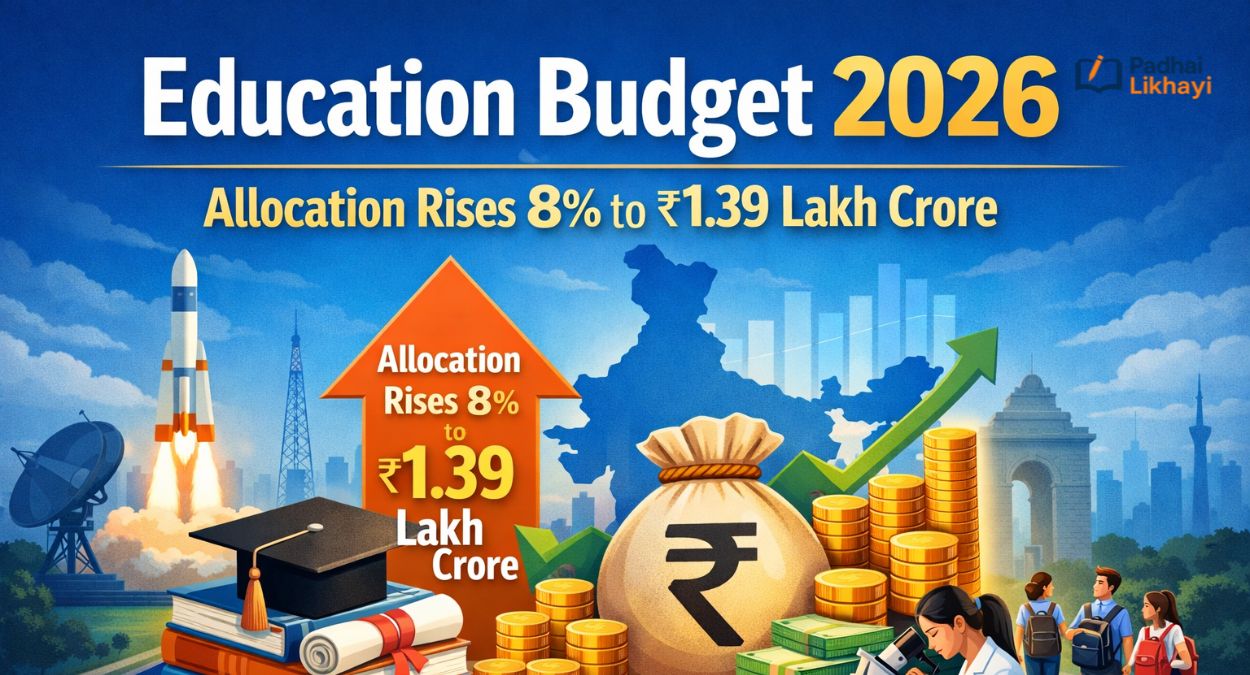
Education and skill development have been given strong priority in the Education Budget 2026, as the Union Government increased the total allocation to ₹1.39 lakh crore for the financial year 2026–27. This marks a rise of over 8 per cent compared to the previous year and represents the highest-ever budgetary support for the education sector in India.
The increased spending under the Education Budget 2026 highlights the government’s long-term vision of building a skilled, knowledgeable, and future-ready population. Investment in education, research, innovation, and employability has been placed at the centre of economic and social planning.
The education allocation forms nearly 2.6 per cent of the total estimated government expenditure of ₹53.5 lakh crore for FY27. This clear rise in funding shows that education is being treated as a key driver of inclusive growth, job creation, and technological progress.
Education Budget 2026 Allocation
While presenting the Union Budget in Parliament, Finance Minister Nirmala Sitharaman announced that the Ministry of Education has received an allocation of ₹1.39 lakh crore for FY 2026–27. This is an increase of 8.27 per cent from the ₹1.28 lakh crore allocated in the previous financial year.
Funds have been carefully distributed between school education and higher education to ensure balanced development across all stages of learning under the Education Budget 2026.
- ₹83,562.26 crore has been allocated for school education
- ₹55,727 crore has been allocated for higher education
School education saw a growth of 6.35 per cent, focusing on access, quality teaching, and learning infrastructure. Higher education recorded a stronger rise of 11.28 per cent, showing the government’s focus on research, advanced learning, and skill-based education.
This structured allocation reflects the aim to strengthen India’s education system from the foundation level to higher learning and professional training.
Higher Education Gets Major Boost in Education Budget 2026
One of the key highlights of the Education Budget 2026 is the strong push for higher education. The higher growth rate in funding shows the government’s intent to strengthen universities, colleges, and research institutions across the country.
The increased budget is expected to support:
- Research and innovation in emerging fields
- Skill development aligned with industry needs
- Expansion of quality higher education institutions
- Better learning infrastructure and faculty support
Special attention has been given to areas such as artificial intelligence, science, technology, and professional education. The government aims to ensure that Indian students are prepared for global opportunities and modern job markets.
Education experts have noted that the higher education focus aligns well with the National Education Policy, which emphasises multidisciplinary learning, research excellence, and global competitiveness.
Education Budget 2026 Brings Relief Through TCS Reduction
The Education Budget 2026 also provided direct financial relief to students and families, especially those planning education abroad.
The Finance Minister announced a reduction in Tax Collected at Source (TCS) under the Liberalised Remittance Scheme (LRS) for education and medical purposes TCS was reduced from 5 per cent to 2 per cent.
In addition, TCS on overseas tour packages has also been reduced to 2 per cent without any threshold limit.
This move is expected to:
- Reduce the financial burden on students
- Make overseas education more affordable
- Ease cash flow pressure for families
The decision has been widely welcomed, as it directly benefits students pursuing higher studies outside India and supports global learning opportunities.
Education Budget 2026 Focus on Inclusivity and Women’s Education
Inclusivity remains a key pillar of the Education Budget 2026, with special attention given to women’s education and participation in higher studies.
The government announced plans to establish one girls’ hostel in every district, in partnership with state governments. This initiative aims to improve access to higher education for women, provide safe accommodation for female students, and increase enrolment of girls in colleges and universities.
There is also a strong focus on encouraging women to pursue education in science, technology, engineering, and mathematics (STEM) fields.
Union Education Minister Dharmendra Pradhan stated that the enhanced allocation reflects the Prime Minister’s vision of building a developed and inclusive India. He highlighted the growing role of women in science and technology and reaffirmed the government’s commitment to strengthening education infrastructure.
Veterinary Education, AVGC Labs, and Hospitality Sector Support
The Education Budget 2026 introduced targeted initiatives to address skill gaps in specialised sectors.
To tackle the shortage of trained veterinary professionals, the government proposed a loan-linked capital subsidy to encourage private investment in veterinary and para-veterinary colleges, hospitals and diagnostic laboratories, and breeding and animal care centres.
This initiative aims to add over 20,000 trained professionals to the veterinary sector.
Recognising the rapid growth of the Animation, Visual Effects, Gaming, and Comics (AVGC) industry, the government announced support for the Indian Institute of Creative Technologies, Mumbai. As part of this plan:
AVGC Content Creator Labs will be set up in 15,000 secondary schools. Similar labs will be established in 500 colleges across the country.
The hospitality sector also received support, with plans to upgrade the National Council for Hotel Management and Catering Technology into a National Institute of Hospitality. Additionally, a pilot programme will train 10,000 tourist guides across 20 destinations through a 12-week hybrid course.
Support for Research, Astronomy, and Flagship Education Schemes
The Education Budget 2026 reinforced India’s commitment to research and scientific advancement. The government announced plans to upgrade telescope infrastructure and establish new astronomy and astrophysics facilities at four locations.
Education leaders welcomed the increased allocation, stating that it reflects long-term investment in people, knowledge, and innovation.
The Budget also continued strong support for key flagship schemes, including ₹42,100 crore for Samagra Shiksha, ₹12,750 crore for PM POSHAN, and ₹7,500 crore for PM SHRI Schools.
These schemes play a vital role in improving school education quality, nutrition, and infrastructure across the country.
Also Check:
Calicut University Result 2025 Out for UG and PG Exams
Education Budget 2026 FAQs
Q1. What is the total allocation under the Education Budget 2026?
Ans. The Education Budget 2026 allocates ₹1.39 lakh crore to the Ministry of Education.
Q2. How much has the education budget increased in 2026?
Ans. The allocation has increased by over 8 per cent compared to the previous year.
Q3. Which sector received more growth in Education Budget 2026?
Ans. Higher education received a higher growth rate than school education.
Q4. What relief did students get in Education Budget 2026?
Ans. TCS under LRS for education was reduced from 5 per cent to 2 per cent.
Q5. What is the focus of Education Budget 2026?
Ans. The focus is on quality education, skill development, inclusivity, and employability.