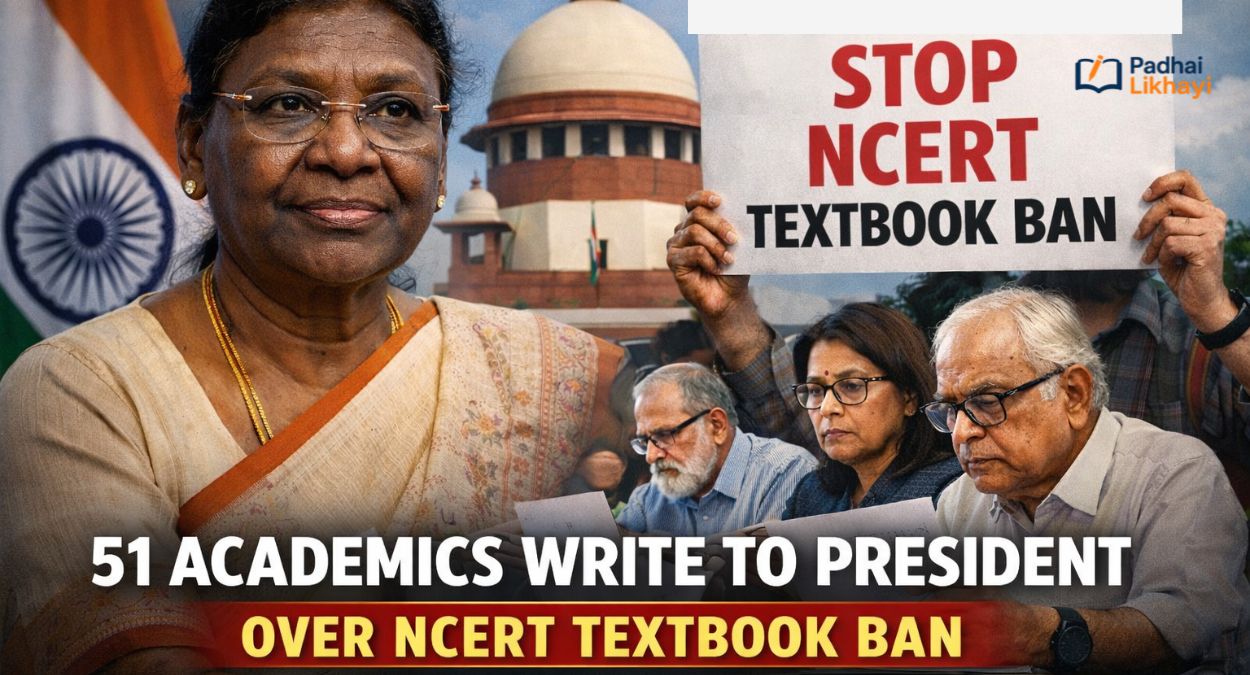
The debate around the NCERT textbook ban has taken a serious turn as a group of 51 academics and scholars has written to President Droupadi Murmu seeking urgent intervention. The letter raises deep concerns over the implications of recent judicial actions on India’s education system, calling the situation a potential threat to academic freedom.
The issue stems from the ban on a chapter in an NCERT Class 8 textbook and subsequent directions affecting contributors associated with the content. The development has triggered a wider discussion on the limits of judicial intervention in educational matters and its long-term consequences.
NCERT Textbook Ban and Supreme Court Orders Under Scrutiny
The controversy surrounding the NCERT textbook ban began after the Supreme Court of India passed an order on February 26. The court directed the removal of a chapter titled “The Role of the Judiciary in Our Society” from the Class 8 textbook Exploring Society: India and Beyond.
The court described the chapter as “offending” and stated that it appeared to malign the judiciary. This decision led to immediate action from NCERT, including an apology and internal review.
Later, on March 11, the court issued another directive. It asked governments and publicly funded institutions to immediately disassociate from three individuals involved in drafting the chapter. These developments intensified the debate and brought the NCERT textbook ban into national focus.
Lucknow University Academics Letter Raises Key Concerns
The Lucknow University academics letter represents a collective voice of concern from scholars across institutions. The signatories argue that the NCERT textbook ban could have far-reaching consequences for the Indian education system.
They emphasized that such actions may discourage open discussion and critical thinking in classrooms. According to the letter, educational content should be open to review and debate rather than abrupt removal.
The academics also pointed out that the ban prevents teachers, students, and experts from objectively analyzing the chapter. This, they argue, undermines the purpose of education, which is to promote inquiry and understanding.
President Murmu NCERT Issue: Appeal for Intervention
In the President Murmu NCERT issue, the academics have urged the President to intervene and request the Ministry of Education to address the matter with the court.
Their demands include withdrawing the NCERT textbook ban while allowing the textbook to remain accessible without the controversial chapter. This approach, they believe, strikes a balance between addressing concerns and preserving educational material.
Additionally, they have called for the reversal of actions taken against the three contributors. The scholars have recommended forming an expert panel that includes educationists to review such content in line with the National Education Policy 2020.
The appeal highlights the need for a collaborative approach in resolving disputes related to academic material.
Supreme Court NCERT Ban and Its Impact on Education
The Supreme Court NCERT ban has implications that extend beyond a single textbook. Academics fear that it may create an environment of caution and fear among educators and authors. If writers and teachers begin to self-censor, it could limit the diversity of perspectives presented in textbooks. This would ultimately affect the quality of education.
The scholars have also highlighted that the ban has halted meaningful discussions about challenges faced by institutions like the judiciary. By removing such content, opportunities for critical engagement are reduced. The NCERT textbook ban may also influence how future textbooks are written, potentially leading to a more restricted academic environment.
Also Check:
SOF Level 2 Result 2026 OUT for NSO, IMO, IEO at results.sofworld.org
CBSE Class 12 Maths Paper QR Code Surprise: Students Get ‘Rickrolled’
FAQs
Q.1. What is the NCERT textbook ban about?
Ans. It refers to the removal of a Class 8 NCERT chapter following a Supreme Court order citing objectionable content.
Q.2. Why did academics write to the President?
Ans. They raised concerns about academic freedom and requested intervention in the NCERT textbook ban issue.
Q.3. What did the Supreme Court direct in this case?
Ans. The court banned a chapter and asked institutions to disassociate from three contributors.
Q.4. What are the main concerns raised by scholars?
Ans. They highlighted judicial overreach, lack of natural justice, and impact on education.
Q.5. How could this issue affect academic freedom in India?
Ans. It may create fear among educators and limit open discussion in academic content.