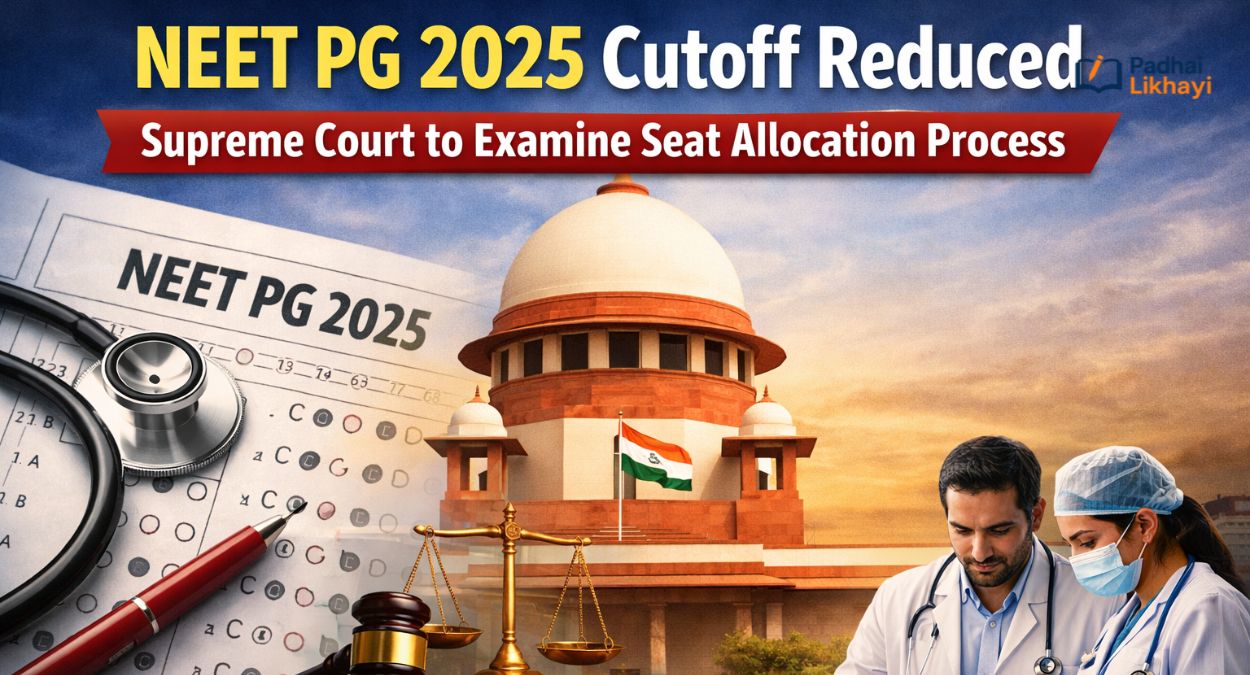
The issue of NEET PG 2025 Cutoff Reduced has become a major development in postgraduate medical admissions across India. The recent NEET PG 2025 Cutoff Reduction for MD, MS, and MDS courses has raised important questions about merit, transparency, and academic standards. The matter has now reached the Supreme Court on NEET PG 2025, which is examining the reasons behind the sharp drop in the qualifying percentile and its possible impact on medical education.
This decision directly affects thousands of MBBS graduates waiting for admission through the NEET PG Seat Allocation Process. While the government has defended the move as necessary to avoid seat wastage, concerns have been raised about whether lowering the cutoff could affect the quality of postgraduate training.
This article provides a clear and detailed explanation of the controversy, the Centre’s position, the issue of private college fees, and what it means for NEET PG Counselling 2025.
NEET PG 2025 Cutoff Reduced
The announcement of NEET PG 2025 cutoff reduction has significantly changed the admission scenario for postgraduate medical courses. The qualifying percentile was lowered after Round-2 of counselling revealed a large number of vacant seats under the All India Quota (AIQ).
According to official data presented before the court, over 31,000 AIQ seats were available after earlier rounds, and around 9,600 seats remained vacant. Due to this situation, the authorities implemented the NEET PG 2025 Cutoff Reduction, making more than one lakh additional candidates eligible for Round-3 counselling.
The main objective behind reducing the cutoff was to ensure that postgraduate seats do not go vacant. Medical education infrastructure is limited and valuable, and unfilled seats may affect the overall healthcare system. By lowering the qualifying percentile, more registered MBBS doctors were allowed to participate in the admission process.
However, this move has led to legal scrutiny and public debate.
Supreme Court on NEET PG 2025: Key Concerns Raised
The Supreme Court on NEET PG 2025 is examining whether the sudden reduction in cutoff could impact the standards of postgraduate medical education. The court has sought clarification on the following key points:
- What were the exact reasons behind the sharp reduction?
- Was the decision taken after proper evaluation?
- Could it dilute the merit-based admission system?
- Does it affect the overall quality of healthcare education?
The court is particularly concerned about maintaining academic standards in MD, MS, and MDS programmes. Postgraduate medical education requires advanced knowledge and clinical skills. Therefore, any policy change must ensure that the quality of training remains strong.
The hearing is focused on understanding whether the decision was based on administrative necessity or if it could unintentionally compromise the integrity of the examination process.
The outcome of this review may influence future policy decisions related to NEET PG.
Government’s Stand on NEET PG 2025 Cutoff Reduction
The government has defended the NEET PG 2025 Cutoff Reduction before the court. It clarified that candidates appearing for NEET PG are already qualified doctors holding MBBS degrees and valid licenses. Therefore, lowering the cutoff does not mean admitting unqualified individuals.
The Centre argued that:
- All candidates are registered medical graduates.
- The reduction was necessary to prevent large-scale seat vacancies.
- Vacant postgraduate seats weaken the healthcare delivery system.
- The move ensures optimal use of available medical infrastructure.
The government further explained that the reduction allowed approximately 1,00,000 additional candidates to participate in the counselling process. This step was described as a practical measure to strengthen the healthcare workforce, especially in specialized fields.
From the government’s perspective, the NEET PG 2025 Cutoff Reduced decision aims to balance merit with national healthcare needs.
NEET PG Seat Allocation Process Under Review
The NEET PG Seat Allocation Process is also under judicial examination. The counselling process includes multiple rounds under the All India Quota and State Quota. Despite several rounds, a significant number of seats remained vacant this year.
The allocation process generally includes:
- Round-1 counselling
- Round-2 counselling
- Mop-up round
- Stray vacancy round
When seats remain vacant even after multiple rounds, authorities may revise eligibility criteria. In this case, the NEET PG 2025 Cutoff Reduced decision was implemented to increase participation in later rounds.
The court is reviewing whether the seat allocation mechanism needs reforms to ensure better planning and transparency. Experts suggest that better forecasting of seat demand, improved counselling schedules, and stricter monitoring could reduce last-minute policy changes.
A structured and transparent NEET PG seat allocation process is essential to maintain trust among aspirants.
NEET PG Counselling 2025 and Fee Structure Debate
The issue of NEET PG Counselling 2025 is closely linked with concerns about fee differences between government and private medical colleges.
Government medical colleges usually charge tuition fees ranging between ₹8,000 and ₹30,000 annually for postgraduate courses. In contrast, private medical colleges may charge between ₹95 lakh and ₹1.5 crore for similar programmes.
This large fee gap creates challenges for many meritorious candidates who cannot afford private college fees. As a result, some seats in private institutions remain vacant even when eligible candidates are available.
Regulations by the National Medical Commission (NMC) state that private college fees should not exceed a certain limit compared to government college fees. Allegations have been raised that some institutions may not be fully complying with these guidelines.
During discussions around NEET PG Counselling 2025, the court has also considered whether high private college fees contribute to seat vacancies. If affordability remains a major barrier, lowering the cutoff alone may not solve the issue.
The broader debate now includes:
- Fee regulation enforcement
- Transparency in admissions
- Financial accessibility for students
- Ensuring quality education across institutions
FAQs
Q1. What is the reason behind NEET PG 2025 Cutoff Reduced?
Ans. The cutoff was reduced to prevent large-scale seat vacancies in postgraduate medical courses.
Q2. Why is the Supreme Court reviewing NEET PG 2025 Cutoff Reduction?
Ans. The court is examining whether the reduction affects merit and academic standards.
Q3. How does NEET PG Seat Allocation Process work?
Ans. It involves multiple counselling rounds under All India and State quotas to fill available seats.
Q4. Will NEET PG Counselling 2025 be affected by the court’s decision?
Ans. Yes, the court’s observations may influence counselling procedures and policies.
Q5. Does lowering the cutoff mean unqualified candidates are admitted?
Ans. No, all candidates appearing for NEET PG are licensed MBBS doctors.