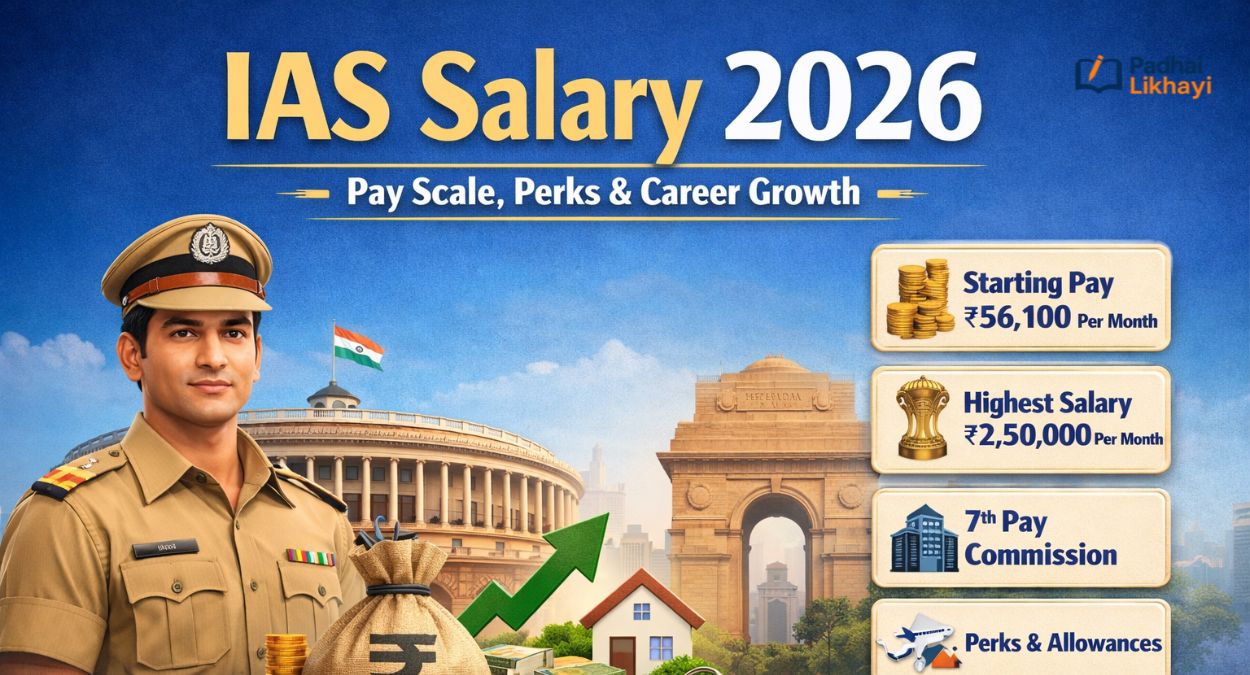
The basic IAS Salary in 2026 starts at ₹56,100 per month and gradually increases with experience, promotions, and higher responsibilities. An IAS officer serving as the Cabinet Secretary of India can earn up to ₹2,50,000 per month at the top level. In addition to the basic pay, officers are entitled to various allowances such as Dearness Allowance (DA), House Rent Allowance (HRA), and Transport Allowance (TA), which may differ depending on the posting location and role.
Many young aspirants choose civil services for the prestige and respect associated with the position and for the competitive salary, job security, benefits, and decision-making authority that come with the role.
IAS Salary 2026
The entry-level IAS salary in India starts at ₹56,100 per month. The monthly pay can rise to around ₹1,32,000 at senior administrative positions with regular promotions, increased responsibilities, and years of service. At the highest rank, the Cabinet Secretary, the top position in the IAS hierarchy, receives a salary of nearly ₹2,50,000 per month, usually after more than three decades of service.
Apart from the basic pay, IAS officers are also entitled to Dearness Allowance (DA), which is currently about 9% of the basic salary. Over the year, this significantly boosts total earnings, making the overall compensation package more attractive and competitive.
IAS Salary 2026 after 7th Pay Commission
After the 7th Pay Commission, the old pay grade system for civil servants was replaced with a structured Pay Level framework. Under this system, the IAS Officer Salary in 2026 is determined mainly by Basic Pay, along with additional benefits like Dearness Allowance (DA), House Rent Allowance (HRA), and Travel Allowance (TA). The revised structure brings more clarity and ensures steady salary growth as officers gain experience, seniority, and higher administrative roles.
All IAS officers begin their careers with a standard pay level, and their earnings gradually increase through promotions and years of service. This transparent salary progression, combined with authority, job security, and benefits, makes the IAS one of the most preferred career choices among UPSC aspirants.
Check the IAS Officer Salary Structure After 7th Pay Commission in the table below:
| Basic Pay (₹) | Years of Service | District Administration | State Secretariat | Central Secretariat |
|---|---|---|---|---|
| 56,100 | 1–4 | Sub-Divisional Magistrate | Under Secretary | Assistant Secretary |
| 67,700 | 5–8 | Additional District Magistrate | Deputy Secretary | Under Secretary |
| 78,800 | 9–12 | District Magistrate | Joint Secretary | Deputy Secretary |
| 1,18,500 | 13–16 | District Magistrate | Special Secretary-cum-Director | Director |
| 1,44,200 | 16–24 | Divisional Commissioner | Secretary-cum-Commissioner | Joint Secretary |
| 1,82,200 | 25–30 | Divisional Commissioner | Principal Secretary | Additional Secretary |
| 2,05,400 | 30–33 | No Equivalent Rank | Additional Chief Secretary | No Equivalent Rank |
| 2,25,000 | 34–36 | No Equivalent Rank | Chief Secretary | Secretary |
| 2,50,000 | 37+ Years | No Equivalent Rank | No Equivalent Rank | Cabinet Secretary of India |
Highest IAS Officer Salary
According to the 7th Pay Commission pay structure, the highest salary an IAS officer can receive is ₹2,50,000 per month. This top pay level is reserved for the Cabinet Secretary of India, the most senior position in the administrative system. Achieving this rank usually requires more than 37 years of dedicated service, extensive experience, and a strong record of leadership in the civil services.
Rank-Wise IAS Salary Structure
IAS officers receive regular promotions based on their experience, performance, and years of service. With each promotion, their responsibilities increase along with their pay level and basic salary. Under the 7th Pay Commission, the salary system has been organised into clear pay levels, ensuring steady growth throughout an officer’s career. Candidates can check the rank-wise IAS Salary Structure (7th Pay Commission) in the table below:
| IAS Rank-Wise Post | Pay Level | Basic Pay (Per Month) | Years of Experience |
|---|---|---|---|
| SDM, Under Secretary, Assistant Secretary | Level 10 | ₹56,100 | 0–4 years |
| ADM, Deputy Secretary, Under Secretary | Level 11 | ₹67,700 | 4–9 years |
| District Magistrate, Joint Secretary, Deputy Secretary | Level 12 | ₹78,800 | 9–12 years |
| District Magistrate, Director, Deputy Secretary | Level 13 | ₹1,18,500 | 12–16 years |
| Divisional Commissioner, Secretary-cum-Commissioner, Joint Secretary | Level 14 | ₹1,44,200 | 16–25 years |
| Divisional Commissioner, Principal Secretary, Additional Secretary | Level 15 | ₹2,05,400 | 25–30 years |
| Additional Chief Secretary | Level 16 | ₹2,50,000 | 30+ years |
| Chief Secretary / Secretary | Level 17 | ₹2,25,000 | 34–36 years |
| Cabinet Secretary of India | Level 18 | ₹2,50,000 | 37+ years |
IAS Salary After 10 Years
The salary of an IAS officer increases gradually with experience, promotions, and annual increments. After around 10 years of service, officers usually move to higher pay levels under the government’s Pay Matrix, leading to a noticeable rise in monthly earnings. At this stage, many officers hold senior administrative roles, and their basic pay can reach approximately ₹1,44,200 per month at Pay Level 14. However, the exact salary may differ depending on posting location, performance, and career progression.
Here is an estimated overview of IAS salary growth around the 10-year mark:
- Level 12 (District Magistrate): ₹78,800 per month
- Level 13 (Joint Secretary/Director): ₹1,18,500 per month
- Level 14 (Additional Secretary/Equivalent): ₹1,44,200 per month
- Level 15 (Principal Secretary/Equivalent): ₹1,82,200 per month
These figures are indicative and may vary based on allowances, promotions, and official responsibilities.
IAS Grade Pay
Earlier, IAS salaries were structured with a Grade Pay system, which has now been integrated into the Pay Matrix under the 7th Pay Commission. The grade pay initially started at ₹5400 for entry-level posts such as Sub-Divisional Magistrate (SDM) or Under Secretary and increased with higher ranks and responsibilities. Check the IAS Grade Pay Structure in the table below:
| Pay Band (₹) | Grade Pay (₹) | Pay Matrix Level | Designations |
|---|---|---|---|
| 15,600–39,100 | 5400 | Level 10 | SDM / Under Secretary (State) / Assistant Secretary (Central) |
| 15,600–39,100 | 6600 | Level 11 | ADM / Deputy Secretary (State) / Under Secretary (Central) |
| 15,600–39,100 | 7600 | Level 12 | District Magistrate / Joint Secretary (State) / Deputy Secretary (Central) |
| 37,400–67,000 | 8700 | Level 13 | Director (GOI) / Additional Commissioner (IRS) / Joint Commissioner |
| 37,400–67,000 | 10,000 | Level 14 | Inspector General / Commissioner / Joint Secretary (GOI) |
| 67,000–79,000 | — | Level 15 | Additional Secretary (GOI) / Principal Secretary (State) |
| 80,000 (Fixed) | — | Level 17 | Chief Secretary (State) / Secretary (GOI) |
| 90,000 (Fixed) | — | Level 18 | Cabinet Secretary of India |
IAS Perks & Allowances
The IAS Salary 2026 is divided into different pay levels, and the total earnings of an officer depend on their rank, experience, and posting. Apart from the basic pay, IAS officers receive several allowances and benefits that increase their overall compensation. These perks are designed to support their professional responsibilities and maintain a comfortable standard of living.
Dearness Allowance (DA):
Dearness Allowance is an important part of the salary and is revised periodically by the government to adjust for inflation. It significantly increases the total monthly income of an IAS officer.
House Rent Allowance (HRA):
HRA depends on the city of posting and generally ranges between 8% and 24% of the basic pay. This allowance helps officers manage accommodation expenses when government housing is not provided.
Medical Allowance:
IAS officers are eligible for medical benefits and reimbursements for approved treatments, ensuring financial support during health-related needs.
Other Benefits and Allowances:
Additional perks may include transport allowance, domestic help support, official travel expenses, mobile and communication reimbursements, along with pension and retirement benefits.
IAS Officer Career Growth
The career path of an Indian Administrative Service (IAS) officer follows a structured progression, moving from training roles to senior leadership positions in state and central governments. With each promotion, officers take on greater administrative authority, policy responsibilities, and decision-making power. Throughout their journey, IAS officers gain deep experience in governance, public administration, and policy implementation at district, state, and national levels. Check the career Growth of an IAS Officer un the table below:
| Career Stage / Designation | Key Responsibilities |
|---|---|
| Probationary Officer (Entry Level) | Undergo training in administration, governance, law, and policymaking while learning how government systems function. |
| Sub-Divisional Magistrate (SDM) | Manage a sub-division, maintain law and order, supervise development schemes, and handle revenue-related work. |
| District Magistrate (DM) / Collector / Deputy Commissioner | Lead district administration, oversee policy implementation, manage land and revenue matters, and ensure public safety. |
| Divisional Commissioner | Supervise multiple districts, coordinate regional administration, and monitor large-scale government projects. |
| Secretary / Additional Secretary / Joint Secretary (State Govt.) | Assist in policy formulation, implement state-level programs, and provide administrative support to ministers. |
| Director / Additional Director (State Departments) | Head specific departments, monitor policy execution, and evaluate program performance. |
| Principal Secretary / Additional Chief Secretary / Chief Secretary | Serve as top state bureaucrats, coordinate between departments, and guide major policy decisions. |
| Central Government Positions | Work in central ministries on deputation, contribute to national policy planning, and implement flagship schemes. |
| Additional Secretary / Joint Secretary / Secretary (Central Ministries) | Handle national-level policymaking, supervise projects, and manage inter-ministerial coordination. |
| Cabinet Secretary (Apex Position) | The highest bureaucratic post in India; leads the civil services and coordinates key decisions across ministries. |
Also Check:
UPSC Eligibility Criteria 2026
IAS Salary 2026 FAQs
Q.1. What is the starting IAS Salary in 2026?
Ans. The starting IAS salary is ₹56,100 per month at Pay Level 10, excluding allowances like DA, HRA, and TA.
Q.2. What is the highest salary an IAS officer can get?
Ans. The highest IAS salary is ₹2,50,000 per month, which is offered to the Cabinet Secretary of India, the senior-most bureaucratic position.
Q.3. What allowances are included in IAS Salary 2026?
Ans. IAS officers receive Dearness Allowance (DA), House Rent Allowance (HRA), Transport Allowance (TA), medical benefits, travel reimbursements, and retirement benefits.
Q.4. What is the IAS salary after 10 years of service?
Ans. After around 10 years, IAS officers may reach Pay Level 13 or 14, with a basic pay ranging from approximately ₹1,18,500 to ₹1,44,200 per month.
Q.5. How does the 7th Pay Commission affect IAS salary?
Ans. The 7th Pay Commission introduced a Pay Matrix system that replaced grade pay, ensuring structured salary growth based on experience, promotions, and responsibilities.