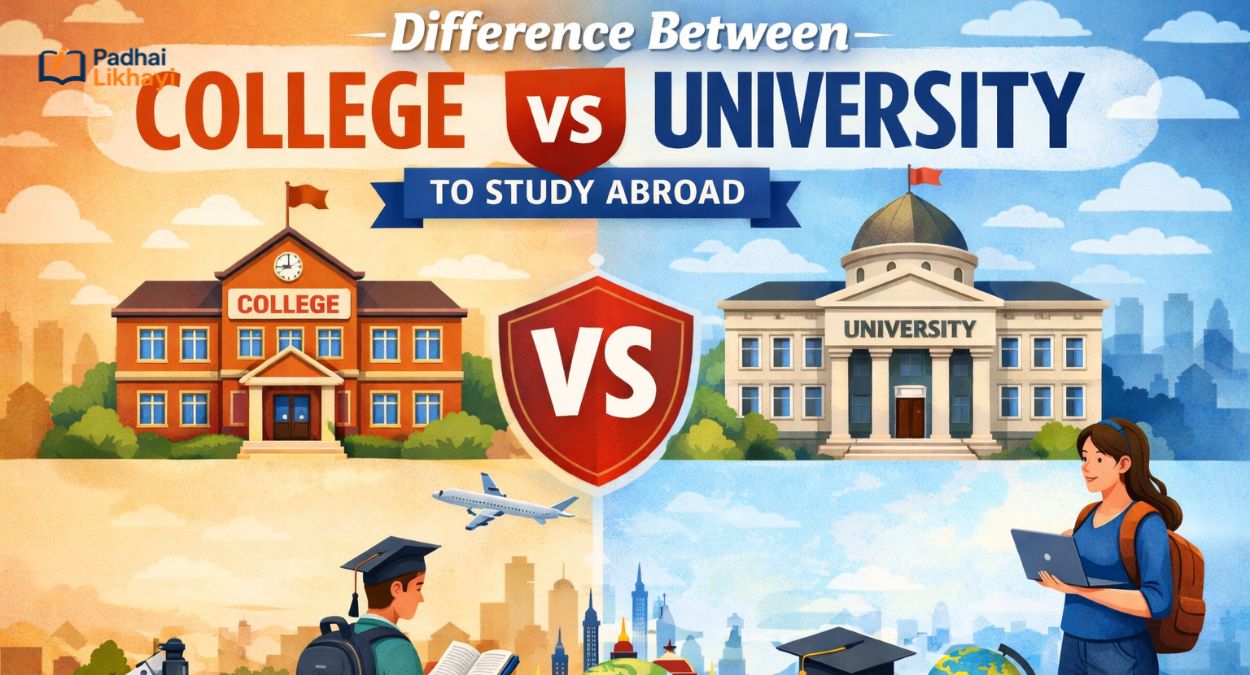
Universities operate on a much larger scale and usually consist of multiple colleges, departments, and research centers under one umbrella. They offer a wide range of courses and programs across different fields of study.
Colleges, in comparison, are smaller and more focused institutions. They usually offer limited courses or specialize in specific disciplines. While universities provide broader academic choices, colleges concentrate on delivering education in selected areas.
Read the full article for complete information and understanding of the difference between universities and colleges.
University Vs College to Study Abroad
Choosing between a university and a college is an important decision, especially for Indian students planning to study abroad. Although both provide higher education, they differ in size, structure, courses, and learning style. Understanding these differences can help you make the right academic choice.
| Key Parameter | University | College |
|---|---|---|
| Meaning | A university is a large, autonomous institution that offers higher education and awards degrees at undergraduate, postgraduate, and doctoral levels. | A college is a smaller institution that offers higher education, mainly at the undergraduate level, and may be autonomous or affiliated with a university. |
| Function & Affiliation | Self-governing bodies with the authority to award degrees. Universities often have multiple colleges, faculties, and research centres under them. | Colleges may award their own degrees or function under a university for accreditation and degree certification. |
| Types | Public Universities, Private Universities, Ivy League Universities, Russell Group Universities, Open Universities | Liberal Arts Colleges, Technical & Vocational Colleges, Community Colleges, Art & Design Colleges, Military Colleges |
| Course Levels Offered | Undergraduate, Postgraduate, Diploma, Certificate, and Doctoral (PhD) programmes | Mainly Undergraduate programmes, along with some diploma and certificate courses |
| Course Options | Offers a wide range of courses across multiple disciplines such as arts, science, engineering, medicine, law, business, and humanities | Offers limited and specialised courses focused on specific fields of study |
| Common Courses | Humanities, Social Sciences, Engineering & Technology, Business & Economics, Fine Arts, Communication & Media Studies, Architecture, Languages, Political & International Studies | Humanities, Mathematics, Computer Science, Business, Engineering, Health Sciences, Education, Fine Arts, Media Studies, Public Administration |
| Learning Approach | Focuses on research-based learning, theoretical knowledge, critical thinking, and independent study | Emphasises practical learning, skill development, hands-on training, and job-oriented education |
| Research Opportunities | Strong focus on research, innovation, publications, and funded projects | Limited research opportunities, mainly focused on applied or practical research |
| Faculty Structure | Large and diverse faculty with professors, researchers, and visiting scholars | Smaller faculty teams with closer student–teacher interaction |
| Student Strength | Large student population due to wide course offerings and international enrolments | Smaller student population, creating a more close-knit academic environment |
| Campus Size & Facilities | Large campuses with libraries, laboratories, hostels, sports complexes, and research centres | Smaller campuses with basic academic and training facilities |
| Flexibility in Learning | Offers multiple learning modes such as full-time, part-time, online, and distance education | Mostly full-time, on-campus programmes with limited flexibility |
| Global Recognition | Generally higher global rankings and international recognition | Recognition depends on affiliation and specialisation |
| Career Opportunities | Suitable for academic careers, research roles, and higher studies | Suitable for quick workforce entry and skill-based professions |
| Cost of Education | Higher tuition fees due to advanced infrastructure, research facilities, and programme diversity | Generally more affordable with lower tuition and living costs |
| Ideal For | Students seeking diverse academic options, research exposure, and long-term academic growth | Students seeking focused education, practical skills, and cost-effective study options |
Also Check: How to Study Abroad for Free in 2026 from India?
Difference Between University and College
Colleges are smaller institutions that offer a limited number of courses and subjects, while a university is a larger body made up of multiple colleges or departments. Universities also have the authority to affiliate colleges and award degrees. Below is an explanation of the difference between a college and a university.
Size and Academic Focus
Colleges are generally smaller in size and mainly focus on undergraduate education. Their academic structure is compact, and course options are limited to specific fields.
Universities, on the other hand, are large institutions with several faculties and departments. They offer a wide range of undergraduate, postgraduate, and doctoral programs, allowing students to continue from a bachelor’s degree to a master’s or Ph.D. within the same institution.
Courses and Research Opportunities
Colleges usually provide fewer research opportunities due to limited resources and infrastructure. Their focus is more on classroom learning and skill-based education.
Universities place strong emphasis on research and innovation. They have advanced laboratories, libraries, and research centers that support academic research along with regular coursework.
Cost and Infrastructure
Because colleges have fewer programs and smaller campuses, their fees are generally more affordable.
Universities often charge higher fees as they provide better facilities, accommodation options, research opportunities, and a broader selection of programs.
Special Programs and Global Exposure
Some colleges offer specialised courses, but these are limited when compared to universities. Student exchange and international exposure programs are more commonly available at universities. Colleges rarely offer exchange or international collaboration programs.
Important Colleges Abroad Country-wise
Below are some well-known colleges and institutions abroad, selected based on rankings, admission policies, and popularity among international students.
SPP Colleges in Canada
The Student Partners Program (SPP) was introduced to help Indian students gain practical and technical education in Canada. These institutions mainly offer certificates and diplomas, with a few degree programs. SPP is a joint initiative between the Association of Canadian Community Colleges (ACCC) and Citizenship and Immigration Canada (CIC), ensuring faster and smoother visa processing.
The following are popular SPP Colleges in Canada:
- Algonquin College
- Bow Valley College
- Cambrian College
- Camosun College
- Canadore College
TAFE Institutes in Australia
TAFE (Technical and Further Education) institutes provide vocational and skill-based training courses ranging from a few months to over three years. These institutes are run by registered training organisations and focus strongly on employment-oriented education, making them a popular choice for students planning to work in Australia after studies.
Notable TAFE Institutes:
- South Metropolitan TAFE
- Northern Sydney Institute of TAFE
- William Angliss Institute of TAFE
- Central Regional TAFE
- Hunter Institute of TAFE
Institutes of Technology and Polytechnics (ITPs) in New Zealand
In New Zealand, ITPs are government-funded institutions that offer affordable and applied education. They are preferred for practical courses as they focus on preparing students for immediate employment after graduation.
The following are the popular ITPs:
- Eastern Institute of Technology
- Manukau Institute of Technology
- Nelson Marlborough Institute of Technology
- NorthTec
- Otago Polytechnic
Top Universities in the World 2026
These universities consistently rank high in global rankings such as QS World University Rankings and Times Higher Education Rankings. Rankings may vary depending on location, subject, and student preference.
The following are some of the top universities worldwide:
- Massachusetts Institute of Technology (MIT), USA
- Imperial College London, UK
- Stanford University, USA
- University of Oxford, UK
- Harvard University, USA
Now that you clearly understand the difference between a university and a college, you can choose the institution that best matches your academic goals, budget, and career plans. Making an informed decision is the first step toward a successful study-abroad journey.
Also Check: How to Apply for Universities Abroad?
FAQs
Q.1. What is the main difference between a university and a college?
Ans. A university is a large institution offering undergraduate, postgraduate, and doctoral programs, while a college is smaller and mainly provides undergraduate or specialised courses.
Q.2. Is a university better than a college for studying abroad?
Ans. It depends on career goals. Universities are suitable for research and higher studies, whereas colleges focus more on practical and job-oriented education.
Q.3. Are colleges abroad more affordable than universities?
Ans. Yes, colleges usually have lower tuition fees and living costs compared to universities due to fewer facilities and smaller campuses.
Q.4. Do colleges abroad offer degree programs?
Ans. Some colleges award their own degrees, while many are affiliated with universities for degree recognition and accreditation.
Q.5. Which is better for quick employment abroad, a university or a college?
Ans. Colleges are often better for quick employment as they emphasise skill-based learning and practical training aligned with industry needs.