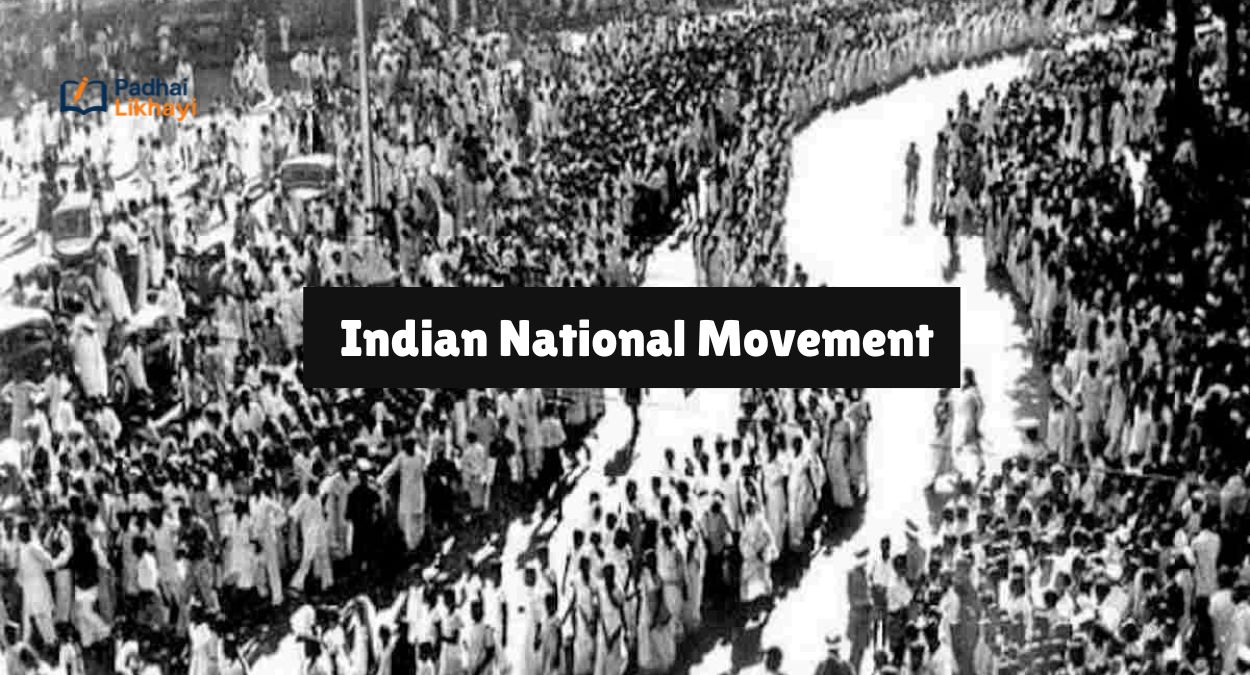
The Indian National Movement was a long and organized struggle by the people of India to end British colonial rule. It began in the mid-19th century and continued until India achieved independence in 1947. This movement was not limited to one region or group. Instead, it united people from different backgrounds, religions, and social classes under one national goal: freedom.
The Indian National Movement developed gradually. In its early stage, leaders demanded limited reforms through peaceful means. Later, the movement became stronger and more widespread with mass participation, non-cooperation, civil disobedience, and revolutionary activities. The leadership of figures such as Mahatma Gandhi, Jawaharlal Nehru, Subhas Chandra Bose, Bal Gangadhar Tilak, and many others gave clear direction and strength to the struggle.
This article explains the phases of the Indian National Movement, its major leaders, important movements, and a clear timeline from 1857 to 1947.
Indian National Movement
The Indian National Movement developed in different phases, showing the changing methods used by Indians to oppose British rule. In the early stage, leaders followed moderate methods such as petitions and constitutional reforms. Over time, later leaders adopted stronger and more direct approaches.
Large-scale movements like the Non-Cooperation Movement, Civil Disobedience Movement, and Quit India Movement involved millions of people across the country. The movement also encouraged social reform and active participation of women and youth, leading to a nationwide sense of unity and awareness.
Regional movements in Bengal, Punjab, Maharashtra, and southern India strengthened the national struggle and supported the common goal of independence.
Revolt of 1857
The Revolt of 1857 marked the first major challenge to British authority in India. It is often called the First War of Indian Independence. Although it did not lead to immediate freedom, it laid the foundation for future nationalist movements.
The revolt began in Meerut and quickly spread to Delhi, Kanpur, Lucknow, and Jhansi. It was caused by multiple factors such as economic exploitation, loss of political power of Indian rulers, religious fears, and dissatisfaction among Indian soldiers.
Important leaders of the Revolt of 1857 included Mangal Pandey, Rani Lakshmibai, Nana Sahib, and Bahadur Shah Zafar. The British eventually suppressed the revolt, but it created a strong feeling of unity and resistance among Indians.
The Revolt of 1857 made the British realize that ruling India without reforms would be difficult. For Indians, it became a symbol of courage and sacrifice and inspired the organized phase of the Indian National Movement.
Moderate Phase of the Indian National Movement (1885–1905)
The Moderate Phase marked the beginning of organized political activity in India. It started with the formation of the Indian National Congress in 1885. Leaders of this phase believed in peaceful methods and constitutional reforms.
Key leaders of the Moderate Phase were Dadabhai Naoroji, Gopal Krishna Gokhale, Surendranath Banerjee, Pherozeshah Mehta, and W.C. Bonnerjee. They followed methods such as petitions, speeches, resolutions, and discussions with British authorities.
The main objectives of this phase were:
- Expansion of legislative councils
- Indian participation in administration
- Economic justice and reduction of taxes
- Political education of the people
Dadabhai Naoroji’s Drain Theory explained how British policies were draining India’s wealth. This economic critique became an important part of the Indian National Movement.
Although the Moderates did not achieve immediate results, they created political awareness and laid a strong foundation for future mass movements.
Extremist Phase of the Indian National Movement (1905–1919)
The Extremist Phase emerged due to dissatisfaction with the slow progress of the Moderate approach. This phase became active after the Partition of Bengal in 1905, which deeply angered Indians.
Important extremist leaders were Bal Gangadhar Tilak, Lala Lajpat Rai, and Bipin Chandra Pal. They believed that freedom could not be achieved through petitions alone.
The objectives of the Extremist Phase included:
- Achievement of Swaraj (self-rule)
- Boycott of British goods
- Promotion of Swadeshi industries
- Strong resistance to British policies
The Swadeshi Movement encouraged people to use Indian-made goods and reject British products. This phase expanded the Indian National Movement to common people, students, and workers.
The Extremists transformed nationalism into a mass emotion and prepared the ground for the Gandhian era.
Gandhian Era and Mass Movements (1919–1947)
The most powerful phase of the Indian National Movement began under the leadership of Mahatma Gandhi. Gandhi introduced non-violence and truth as tools of political struggle. This phase saw massive public participation.
Major movements of this period include:
Non-Cooperation Movement (1920–1922)
This movement aimed to boycott British institutions, schools, courts, and titles. It ended after the Chauri Chaura incident but showed the strength of mass unity.
Civil Disobedience Movement (1930–1934)
It began with the Salt March to Dandi, protesting the British salt tax. This movement gained international attention and challenged British authority openly.
Quit India Movement (1942)
Launched during World War II, this movement demanded immediate British withdrawal from India. Although it was suppressed, it made British rule unsustainable.
Leaders like Jawaharlal Nehru, Sardar Patel, Sarojini Naidu, and Aruna Asaf Ali played key roles during this period. The Gandhian era made the Indian National Movement truly national in character.
Role of Leaders, Women, and Mass Participation
The success of the Indian National Movement was due to the contribution of various sections of society.
- Women leaders like Sarojini Naidu, Kasturba Gandhi, and Annie Besant played active roles in protests and leadership.
- Youth leaders such as Bhagat Singh and Chandrashekhar Azad inspired courage and sacrifice.
- Tribal and peasant movements highlighted local grievances and strengthened national unity.
- Indian National Army (INA) led by Subhas Chandra Bose showed armed resistance and boosted nationalist morale.
This wide participation made the Indian National Movement inclusive and powerful.
Indian National Movement Timeline (1857–1947)
Below is the complete timeline of Indian National Movement:
- 1857 – Revolt of 1857
- 1885 – Formation of Indian National Congress
- 1905 – Partition of Bengal and Swadeshi Movement
- 1917 – Champaran Satyagraha
- 1919 – Jallianwala Bagh Massacre
- 1920 – Non-Cooperation Movement
- 1930 – Salt March and Civil Disobedience Movement
- 1942 – Quit India Movement
- 1947 – Indian Independence
This timeline shows the steady growth of the Indian National Movement over ninety years.
Impact and Outcome of the Indian National Movement
The Indian National Movement resulted in:
- End of British rule in 1947
- Establishment of democracy in India
- Political awareness among citizens
- Social reforms and women’s participation
- Inspiration for global anti-colonial movements
The movement not only brought freedom but also shaped India’s political and moral values.
| Also Check |
|---|
| Union Territories and Their Capitals in India |
| Highest Waterfalls in India |
| Top 10 Highest Mountain Peaks in India |
| National Parks in India 2026 |
FAQs
Q1. What was the main aim of the Indian National Movement?
Ans. The main aim of the Indian National Movement was to end British rule and achieve independence.
Q2. Why is the Revolt of 1857 important in Indian history?
Ans. It marked the first major resistance against British rule and inspired future nationalist movements.
Q3. Who were the main leaders of the Indian National Movement?
Ans. Mahatma Gandhi, Jawaharlal Nehru, Subhas Chandra Bose, and Bal Gangadhar Tilak were key leaders.
Q4. Which movement directly led to independence?
Ans. The Quit India Movement of 1942 played a decisive role in ending British rule.
Q5. When did India gain independence?
Ans. India gained independence on 15 August 1947.