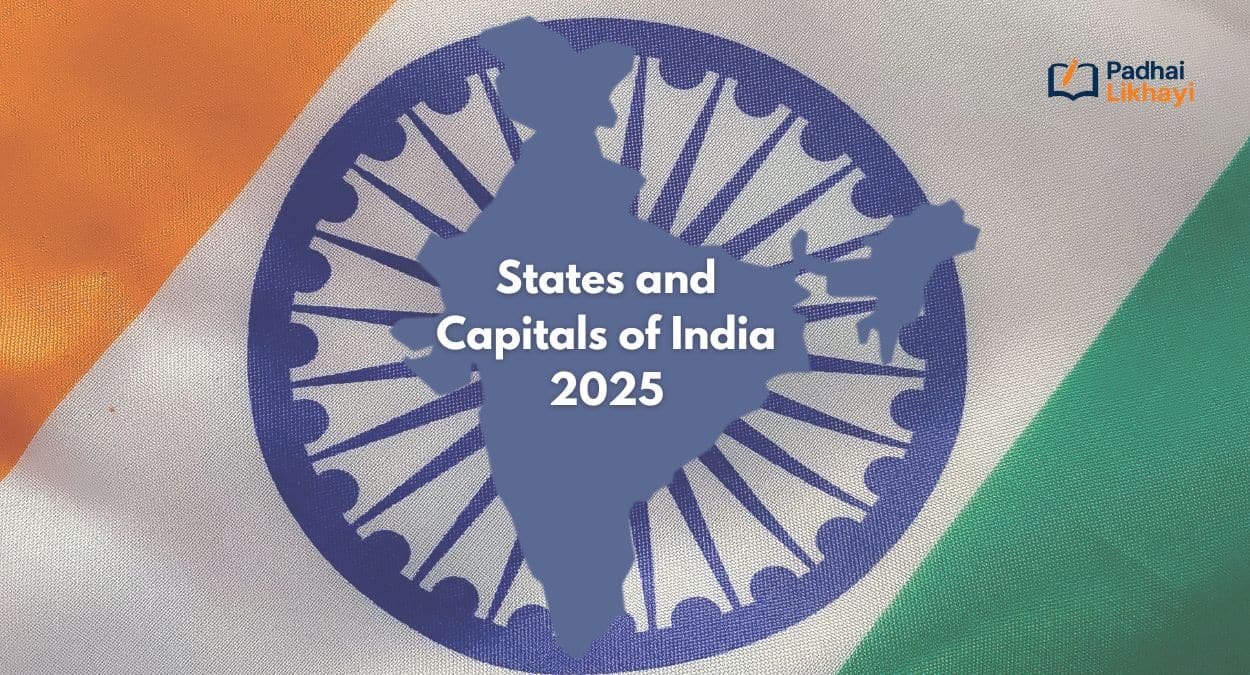
States and Capitals of India: India is the seventh-largest country in the world and also one of the most populated. It is known for its cultural and geographical diversity. The nation is divided into 28 states and 8 Union Territories. Each state and territory has its own capital, history, traditions, and administrative role that makes it unique.
India is located in South Asia. It follows a parliamentary system of government. The Constitution gives power to the central government to form new states or union territories whenever required to manage such a vast country efficiently. Candidates who are preparing for government exams must know the Indian states and capitals. This article provides details on the States and Capitals of India, along with their importance and role in shaping the country.
States and Capitals of India 2025
India is divided into 28 states and 8 union territories. Each state is further divided into districts, which are then subdivided into tehsils, blocks, and villages. Check the complete States and Capitals of India List and their capitals:
| States and Capitals of India List | |||
|---|---|---|---|
| S.No. | State | Capital | Founded Year |
| 1 | Andhra Pradesh | Amaravati | 1953 |
| 2 | Arunachal Pradesh | Itanagar | 1987 |
| 3 | Assam | Dispur | 1947 |
| 4 | Bihar | Patna | 1912 |
| 5 | Chhattisgarh | Raipur | 2000 |
| 6 | Goa | Panaji | 1987 |
| 7 | Gujarat | Gandhinagar | 1960 |
| 8 | Haryana | Chandigarh | 1966 |
| 9 | Himachal Pradesh | Shimla | 1971 |
| 10 | Jharkhand | Ranchi | 2000 |
| 11 | Karnataka | Bengaluru | 1956 |
| 12 | Kerala | Thiruvananthapuram | 1956 |
| 13 | Madhya Pradesh | Bhopal | 1956 |
| 14 | Maharashtra | Mumbai | 1960 |
| 15 | Manipur | Imphal | 1972 |
| 16 | Meghalaya | Shillong | 1972 |
| 17 | Mizoram | Aizawl | 1987 |
| 18 | Nagaland | Kohima | 1963 |
| 19 | Odisha | Bhubaneswar | 1936 |
| 20 | Punjab | Chandigarh | 1947 |
| 21 | Rajasthan | Jaipur | 1949 |
| 22 | Sikkim | Gangtok | 1975 |
| 23 | Tamil Nadu | Chennai | 1956 |
| 24 | Telangana | Hyderabad | 2014 |
| 25 | Tripura | Agartala | 1972 |
| 26 | Uttar Pradesh | Lucknow | 1950 |
| 27 | Uttarakhand | Dehradun | 2000 |
| 28 | West Bengal | Kolkata | 1947 |
Union Territories of India
India is a federal country made up of 28 states and 8 union territories. States have their own elected governments, union territories are directly governed by the Central Government of India. These regions are also divided into districts, but they do not enjoy the same level of autonomy as states.
The National Capital Territory of Delhi (New Delhi) holds a special position as both the capital of India and a union territory. Along with Delhi, the other union territories include Andaman and Nicobar Islands, Chandigarh, Dadra and Nagar Haveli and Daman and Diu, Jammu and Kashmir, Ladakh, Lakshadweep, and Puducherry.
Check the complete list of Union Territories and their Capitals in the table below:
| S.No. | Union Territory | Capital |
|---|---|---|
| 1 | Andaman and Nicobar Islands | Port Blair |
| 2 | Chandigarh | Chandigarh |
| 3 | Dadra and Nagar Haveli and Daman and Diu | Daman |
| 4 | Delhi (National Capital Territory of Delhi) | New Delhi |
| 5 | Ladakh | Leh |
| 6 | Lakshadweep | Kavaratti |
| 7 | Jammu and Kashmir | Srinagar (Summer), Jammu (Winter) |
| 8 | Puducherry | Pondicherry (Puducherry) |
Indian States and Their Languages
India is a land of many languages and dialects. Each state has its own unique language or set of languages, reflecting its culture and heritage. The Indian Constitution recognizes 22 official languages, also known as scheduled languages, which are given importance in administration, education, and literature.
Check the list of Indian States and their Official Languages in the table below:
| State | Language(s) |
|---|---|
| Andhra Pradesh | Telugu, Urdu |
| Arunachal Pradesh | Miji, Apatani, Merdukpen, Tagin, Adi, Honga, Bangni-Nishi |
| Assam | Assamese |
| Bihar | Hindi |
| Chhattisgarh | Hindi |
| Goa | Marathi, Konkani |
| Gujarat | Gujarati |
| Haryana | Hindi |
| Himachal Pradesh | Hindi, Pahari |
| Jharkhand | Hindi |
| Karnataka | Kannada |
| Kerala | Malayalam |
| Madhya Pradesh | Hindi |
| Maharashtra | Marathi |
| Manipur | Manipuri |
| Meghalaya | Khasi, Jaintia, Garo |
| Mizoram | Mizo, English |
| Nagaland | Ao, Konyak, Angami, Sema, Lotha |
| Odisha | Odia |
| Punjab | Punjabi |
| Rajasthan | Rajasthani, Hindi |
| Sikkim | Bhutia, Hindi, Nepali, Lepcha, Limbu |
| Tamil Nadu | Tamil |
| Telangana | Telugu |
| Tripura | Bengali, Tripuri, Manipuri, Kokborok |
| Uttar Pradesh | Hindi |
| Uttarakhand | Hindi |
| West Bengal | Bengali |
Also Check: RRB NTPC UG Result 2025
States and Capitals of India Specialities
India’s states are like colorful chapters of a book, each telling its own story through food, culture, history, and traditions. The following are some specialities of the states and their capitals:
- Andhra Pradesh: Known for its spicy cuisine, temples, and historic landmarks like Charminar and Golconda Fort (Hyderabad was earlier part of Andhra before Telangana was formed).
- Arunachal Pradesh: Famous for its untouched natural beauty, tribal culture, and the serene Tawang Monastery.
- Assam: Home to lush tea gardens, Kaziranga National Park with the one-horned rhinoceros, the lively Bihu dance, and traditional silk weaving.
- Bihar: Rich in history with ancient Patliputra, Bodh Gaya as a Buddhist pilgrimage site, and unique Madhubani paintings.
- Chhattisgarh: Known for its tribal traditions, mineral resources, and the spectacular Chitrakote Waterfalls, often called the “Niagara of India.”
- Delhi (National Capital Territory): A perfect blend of past and present, with India Gate, Red Fort, Qutub Minar, and as the political center of India.
- Goa: Famous for its beaches, Portuguese heritage, vibrant nightlife, and seafood delicacies.
- Gujarat: Renowned for Gir National Park (home of Asiatic lions), the vast Rann of Kutch, Somnath Temple, colorful Navratri celebrations, and Mahatma Gandhi’s Sabarmati Ashram.
- Haryana: Popular for agriculture and industries, while Chandigarh stands out as a planned city with impressive modern architecture.
- Himachal Pradesh: Known for hill stations like Shimla and Manali, adventure sports, peaceful landscapes, and Dharamshala, home of the Dalai Lama.
- Jharkhand: Rich in minerals, tribal culture, and scenic spots like Betla National Park and waterfalls.
- Karnataka: Called the “Silicon Valley of India” for its IT hub Bengaluru, while also famous for Hampi’s ruins, Mysore Palace, and cultural dance forms.
- Kerala: Popular as “God’s Own Country,” with its backwaters, Ayurveda, Kathakali dance, lush greenery, and high literacy rate.
- Maharashtra: The financial capital of India with Mumbai, Bollywood, Ajanta-Ellora Caves, Gateway of India, and iconic street foods like Vada Pav.
- Manipur: Famous for Manipuri dance, the scenic Loktak Lake with floating islands, and vibrant festivals.
States and Capitals of India 2025 FAQs
Q1. How many states and union territories are there in India in 2025?
Ans. India has 28 states and 8 union territories in 2025, each with its own capital city and administrative significance.
Q2. Which is the capital of India?
Ans. The capital of India is New Delhi, which is also recognized as a union territory.
Q3. Which is the newest state of India?
Ans. Telangana is the newest state of India, formed in 2014, with Hyderabad as its capital.
Q4. How many official languages are recognized in India?
Ans. The Indian Constitution recognizes 22 official scheduled languages, including Hindi, Bengali, Telugu, Marathi, Tamil, and others.
Q5. Why is it important to know the states and capitals of India?
Ans. Knowing the states and capitals is essential for students, competitive exam aspirants, and general awareness, as it reflects India’s diversity and administrative structure.