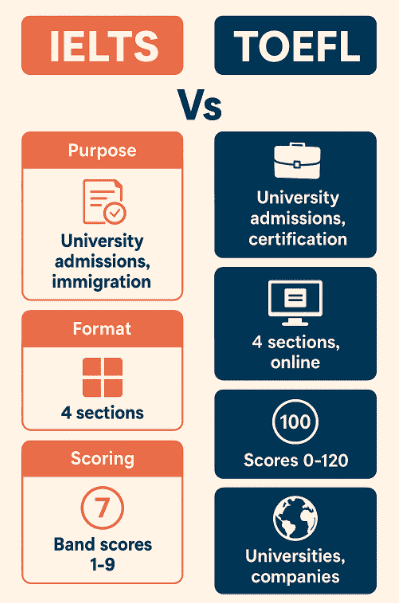
IELTS vs TOEFL: Students who want to study, work, or move abroad to an English-speaking country must prove their English skills. The two most common tests for this are IELTS and TOEFL. Both are accepted by universities, jobs, and immigration offices around the world. These exams test Listening, Reading, Writing, and Speaking abilities.
IELTS and TOEFL check the same skills, but they are different in format, scoring, and structure. This makes many students confused about which one to choose. Common doubts include: Which test is easier? Which one will my university accept? Which exam should I take?
This article will clearly explain the differences between IELTS and TOEFL, such as test format, timing, scoring, and more. So students can decide which exam is right for them.
What Is IELTS?
IELTS is one of the most popular English language tests, accepted in over 150 countries and by more than 11,500 organisations worldwide. It comes in two types:
- Academic for students who want to study in universities abroad.
- General Training for work or migration purposes.
Students can take IELTS in two modes: Computer-based or Paper-based, depending on their preference.
What Is TOEFL?
TOEFL iBT is mainly designed for academic purposes and is widely accepted in more than 160 countries. Many universities in the United States and Canada give preference to the TOEFL.
Both IELTS and TOEFL check Listening, Reading, Writing, and Speaking skills. However, the test format, scoring, and experience are different.
Also Check: RRB NTPC UG Result 2025
IELTS vs TOEFL
Below is a comparison table of IELTS vs TOEFL to make the differences easier to understand. It highlights the key features like test mode, duration, scoring, speaking format, evaluation process, and result timeline.
| Feature | IELTS | TOEFL iBT |
|---|---|---|
| Test Mode | Computer-based & Paper-based | Internet-based (iBT) |
| Test Length | 2 hrs 45 mins | 1 hr 56 mins |
| Score Range | 0–9 Bands | 0–120 |
| Speaking Test | Face-to-face with the examiner | Recorded via computer |
| Marking | Checked by human examiners (experts) | Mostly AI-scored |
| Results Timeline | 2–13 days (2 days for computer, 13 for paper) | 4–8 days |
IELTS vs TOEFL: Test Format
IELTS and TOEFL both evaluate skills in Reading, Listening, Writing, and Speaking, but their test formats and time distribution are different. Below is a comparison of each section in both exams:
| Section | IELTS | TOEFL |
|---|---|---|
| Reading | 40 questions, 60 minutes. Includes three academic passages with a variety of question types such as matching, gap-fill, and short answers. | 20 questions, 35 minutes. Passages are academic and mostly multiple-choice based. |
| Listening | 30 minutes, 40 questions. Includes 4 audio recordings (conversations and monologues). | 36 minutes, 28 questions. Based on lectures and conversations; requires note-taking. |
| Writing | 60 minutes. Task 1: Describe a chart/table (150 words). Task 2: Write an essay (250 words). | 29 minutes. Task 1: Summarize information from a reading and lecture (150–225 words). Task 2: Write an independent essay. |
| Speaking | 11–14 minutes. Conducted face-to-face with an examiner in 3 parts, including an extended discussion. | 16–20 minutes. Consists of 4 tasks with responses recorded on a computer. |
IELTS vs TOEFL: Total Score Comparison
The IELTS and TOEFL exams use different scoring systems. IELTS is graded on a band scale of 0–9, while TOEFL iBT is scored between 0–120. The table below shows how IELTS bands match with TOEFL scores:
| IELTS Score | TOEFL Score |
|---|---|
| 9.0 | 118–120 |
| 8.5 | 115–117 |
| 8.0 | 110–114 |
| 7.5 | 102–109 |
| 7.0 | 94–101 |
| 6.5 | 79–93 |
| 6.0 | 60–78 |
| 5.5 | 46–59 |
| 5.0 | 35–45 |
| 4.5 | 32–34 |
| 0–4 | 0–31 |
IELTS vs TOEFL: Section-Wise Score Comparison
Both exams test Reading, Listening, Writing, and Speaking. Students can check how scores compare for each section below:
Listening Score Comparison
Check the difference between IELTS and TOEFL listening section scores to see how performance translates across both exams in the table below:
| IELTS Score | TOEFL Score |
|---|---|
| 9.0 | 30 |
| 8.5 | 29 |
| 8.0 | 28 |
| 7.5 | 27 |
| 7.0 | 24–26 |
| 6.5 | 20–23 |
| 6.0 | 12–19 |
| 5.5 | 7–11 |
| 5.0 | 4–6 |
| 4.5 | 3 |
| 0 | 0–2 |
Speaking Score Comparison
The table below highlights the equivalence between IELTS speaking bands and TOEFL speaking scores.
| IELTS Score | TOEFL Score |
|---|---|
| 9.0 | 30 |
| 8.5 | 28–29 |
| 8.0 | 26–27 |
| 7.5 | 24–25 |
| 7.0 | 23 |
| 6.5 | 20–22 |
| 6.0 | 18–19 |
| 5.5 | 16–17 |
| 5.0 | 14–15 |
| 4.5 | 12–13 |
| 0–4 | 0–11 |
Reading Score Comparison
Check how IELTS reading scores match TOEFL reading section scores for accurate comparison.
| IELTS Score | TOEFL Score |
|---|---|
| 9.0 | 30 |
| 8.5 | 29 |
| 8.0 | 29 |
| 7.5 | 27–28 |
| 7.0 | 24–26 |
| 6.5 | 19–23 |
| 6.0 | 13–18 |
| 5.5 | 8–12 |
| 5.0 | 4–7 |
| 4.5 | 3 |
| 0–4 | 0–2 |
Writing Score Comparison
Check the difference between IELTS and TOEFL writing scores to know how writing skills are evaluated in the table below:
| IELTS Score | TOEFL Score |
|---|---|
| 9.0 | 30 |
| 8.5 | 30 |
| 8.0 | 30 |
| 7.5 | 29 |
| 7.0 | 27–28 |
| 6.5 | 24–26 |
| 6.0 | 21–23 |
| 5.5 | 18–20 |
| 5.0 | 14–17 |
| 4.5 | 12–13 |
| 0–4 | 0–11 |
IELTS vs TOEFL: Accent and Language
The following are differences between the accent and the language of IELTS and TOEFL:
- Accent: IELTS mainly features British and Australian accents, while TOEFL uses an American accent.
- Vocabulary: IELTS uses British English, whereas TOEFL follows American English and includes some idiomatic expressions.
Also Check: Ministry Announces Viksit Bharat Buildathon 2025 for Students of Classes 6–12
IELTS vs TOEFL: Question Style
Check the question style differences between IELTS and TOEFL in the table below:
| Feature | IELTS | TOEFL |
|---|---|---|
| Approach | Real-life and practical scenarios | More academic in tone |
| Speaking Format | Live interview with an examiner | Recorded responses |
| Writing Tasks | Graph/chart description and essay | Essay plus integrated response from reading/listening tasks |
IELTS: Focuses on practical, real-world tasks. Students may need to describe graphs, maps, or everyday situations. Speaking is face-to-face with an examiner.
TOEFL: Focuses more on academic skills. Writing includes integrated responses based on reading and listening, and speaking is computer-recorded.
IELTS vs TOEFL: Which One is Better?
Choosing between IELTS and TOEFL depends on students’ goals, strengths, and comfort with the test format. IELTS is ideal if a student prefers face-to-face speaking and practical, real-life tasks, and TOEFL suits those comfortable with computer-based typing and academic-style questions. Students must consider test duration, question types, and accents before deciding, so they can select the exam that matches their skills and study or immigration requirements.
IELTS vs TOEFL FAQs
Q.1. Which is easier: IELTS or TOEFL?
Ans. It depends on your strengths. IELTS suits students comfortable with face-to-face speaking, while TOEFL favors those who are good at computer-based typing and academic tasks.
Q.2. Can I use IELTS or TOEFL for immigration?
Ans. Yes, both IELTS and TOEFL are widely accepted by immigration authorities, but IELTS General Training is often preferred for migration purposes.
Q.3. How long are IELTS and TOEFL exams?
Ans. IELTS takes about 2 hours 45 minutes, while TOEFL iBT lasts around 1 hour 56 minutes.
Q.4. Do IELTS and TOEFL test the same skills?
Ans. Yes, both exams assess Listening, Reading, Writing, and Speaking, but the format, scoring, and question style differ.
Q.5. Which exam is accepted in more countries?
Ans. Both IELTS and TOEFL are widely recognized worldwide, but IELTS is accepted in over 150 countries, while TOEFL is accepted in more than 160 countries.